Key takeaways
- Announce and record the order method before revealing the result; run it exactly once.
- Publish real pick-number examples so every participant can verify the snake rotation.
- Define the timer, timeout, no-show, reconnect, keeper, and traded-pick rules before draft night.
- Preserve an intervention log and never privately rewind completed picks after a late arrival.
A fair hockey pool draft order is selected by a method announced before the result, witnessed or recorded, and never rerun because someone dislikes their position. The order is only the first rule. Commissioners must also explain the round rotation, pick clock, no-show behavior, reconnect process, keepers, and any traded selections.
Choose the order method before revealing names
Use one of three defensible approaches: a verifiable random draw, a prior-season rule already written into the constitution, or a balanced event whose scoring is defined before participation. For a random draw, publish the participant list and seed or recording method first. Run it once. Save the output with the date and time.
Avoid “random” methods that let the commissioner keep clicking until the result looks entertaining. Do not exclude absent participants from the draw unless the published rules say absence changes eligibility. Fairness comes from a stable procedure, not equal enthusiasm about every slot.
Turn your draft research into a shortlist
Explore the free tools without an account. Create a pool when your group is ready.
Explain snake rotation with actual pick numbers
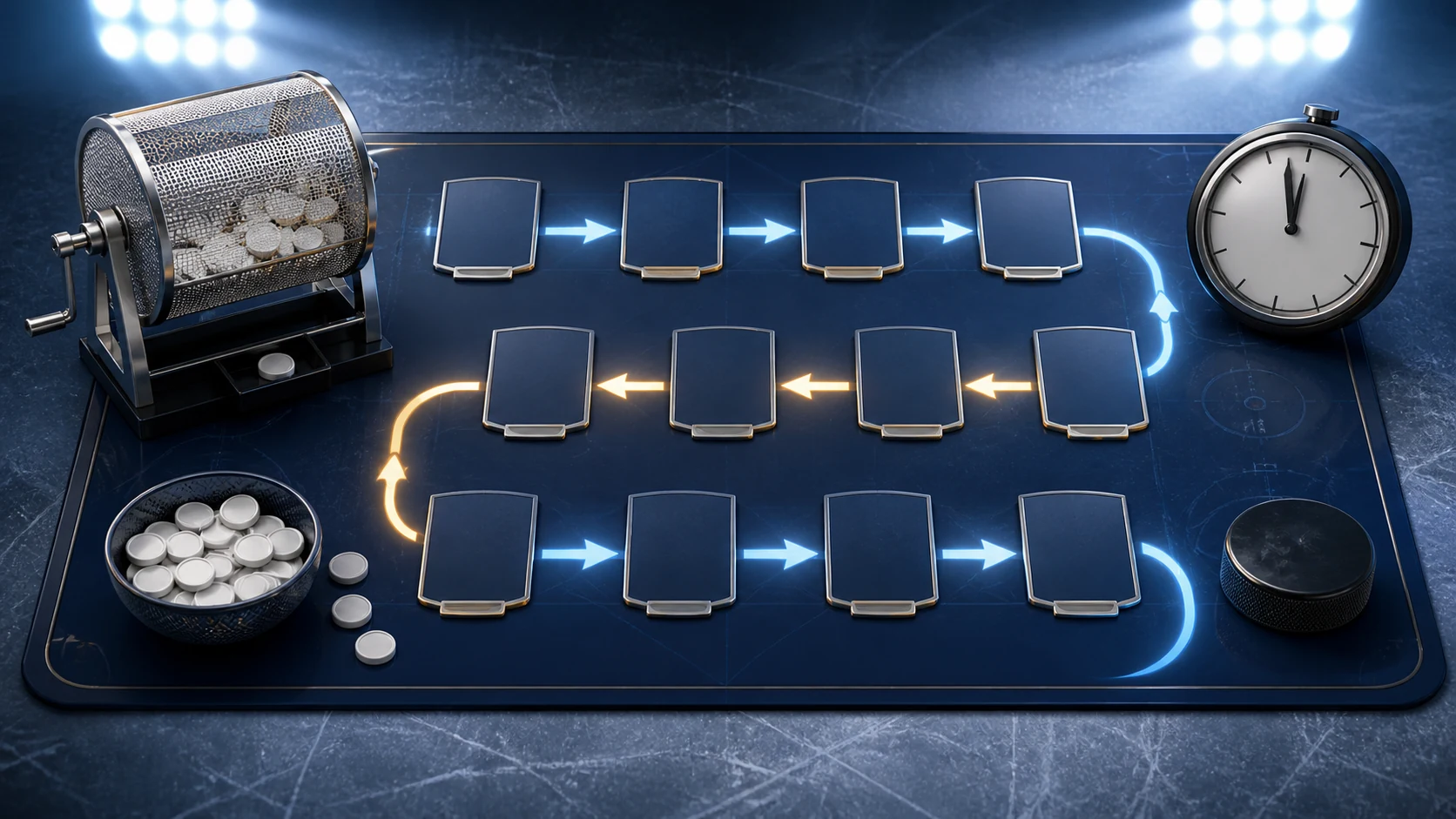
In a standard snake draft, the order reverses each round. The last manager in round one picks first in round two. Round three returns to the original direction. The turnaround manager receives two consecutive selections across the round boundary.
| League size | Slot 1 first three picks | Last slot first three picks |
|---|---|---|
| 8 managers | 1, 16, 17 | 8, 9, 24 |
| 10 managers | 1, 20, 21 | 10, 11, 30 |
| 12 managers | 1, 24, 25 | 12, 13, 36 |
The formula for an odd round is (round − 1) × league size + slot. For an even round it is round × league size − slot + 1. Publish at least the first three picks for every slot so participants can verify the rotation themselves.
Decide whether snake is the right fairness model
Snake rotation reduces the distance between a first-round early selection and the next pick, but it does not make every strategic position identical. Third-round reversal and auction-style drafts are alternatives, each with different tradeoffs. Use the mechanism your platform supports and your rules describe; do not bolt on a custom reversal the room cannot execute reliably.
PoolForge Draft League uses a live snake draft with exclusive player ownership. The Draft League comparison explains why that mechanism differs from Daily lineups and shared player availability.
Set a clock with one visible consequence
Choose a pick length based on group experience, roster depth, and whether a queue or auto-pick is available. A shorter clock keeps momentum; a longer one reduces rushed errors. The rule must say what happens at zero: automatic selection, queue choice, commissioner pause under listed conditions, or another supported outcome.
- Before the draft: publish the clock and timeout consequence.
- During the draft: use the platform timer as the official clock.
- After a timeout: record the automatic or manual action; do not negotiate a private rewind.
A commissioner pause should address a verified room-wide problem or a documented recovery rule, not ordinary indecision.
Write a no-show rule that works without improvisation
Give every manager a way to set a queue or ranking before the event. Define when someone is considered absent and what selects on their behalf. An auto-pick based on a declared queue is more auditable than the commissioner choosing a “helpful” player. If the platform has no automatic option for a scenario, name the neutral fallback before draft night.
Late arrival normally takes over at the current pick; completed choices remain final. Reopening earlier rounds harms everyone who made later choices from the visible player pool. If your group wants a different rule, it must appear in the constitution before the order is drawn.
Prepare for a disconnected manager
- The affected person reconnects using the same account and official room.
- The published queue or auto-pick rule continues unless the outage rule triggers.
- A commissioner pause occurs only under the listed condition.
- The room records any intervention and resumes from a clearly announced state.
Rehearse this sequence with two test accounts. The draft-day runbook provides a timed check from 24 hours before the room opens through final roster verification.
Integrate keepers and traded picks before publishing the board
For a keeper league, state whether a protected player consumes a specific round, the earliest round allowed, and how multiple keepers interact. Resolve all keepers before finalizing the board. For traded picks, record the original round and slot, current owner, approval rule, and deadline. Display the final owner in every affected round.
If the product cannot represent the proposed keeper or pick-trade mechanism exactly, simplify the rule or use a format that does. A manual side ledger is a warning sign because the room may show a different contract from the constitution.
Publish an auditable draft packet
The final packet contains the participant list, order method, timestamped result, round rotation, first three pick numbers per slot, clock, timeout consequence, no-show process, reconnect rule, keepers, traded picks, and commissioner intervention log. Yahoo’s first-party draft documentation illustrates how a mature platform can distinguish snaking and non-snaking rotations and expose commissioner controls; always verify the controls in the product you selected.
Use the rules template to make the packet part of the approved constitution. Once everyone can reproduce the order and predict the timeout outcome, the board is ready.
Turn your draft research into a shortlist
Explore the free tools without an account. Create a pool when your group is ready.
Questions answered
Frequently asked questions
How does a snake draft order work?
The order reverses every round. In a 10-manager league, slot 1 picks 1, 20, and 21, while slot 10 picks 10, 11, and 30.
Should a hockey pool draft order be randomized?
A single verifiable random draw is fair when announced and recorded before the result. A prior-season rule is also fair when it was approved in advance.
What happens when someone misses the draft?
Use the published queue or auto-pick rule. A late manager normally resumes at the current pick; completed selections remain final.
Editorial evidence
Sources
- Manage a Yahoo Fantasy Hockey private-league draft — Yahoo Help
- PoolForge public pool formats — PoolForge